
Klostergarten des Klosters St. Agatha
In der Nähe der Maas, inmitten von Feldern, liegt im äußersten Osten der Provinz Nordbrabant das Kloster St. Agatha. Die Kapelle erhebt sich aus der Landschaft, geschützt durch einen Deich.

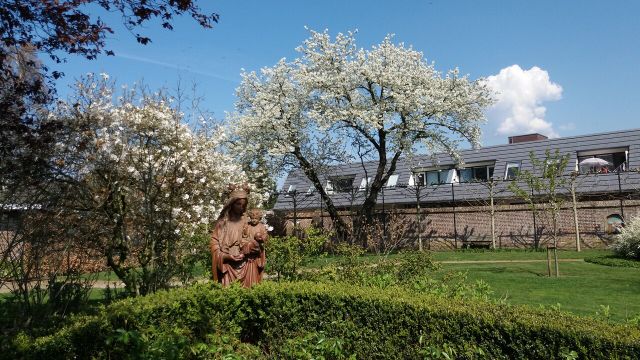


Der Klostergarten von St. Agatha – mit einer Fläche von ca. 2,5 ha – empfängt jährlich Tausende von Spaziergängern und ist der bekannteste Teil des Klosterkomp…
Der Klostergarten von St. Agatha – mit einer Fläche von ca. 2,5 ha – empfängt jährlich Tausende von Spaziergängern und ist der bekannteste Teil des Klosterkomplexes. The garden was laid out in the 18th century and, as a typical monastery garden, serves practical and recreational purposes and features religious elements. The garden is open to visitors from sunrise to sunset. The Crosiers were self-sufficient and for centuries lived largely off the produce of the land: a vegetable garden, fruit trees, fish ponds, chicken coops, and beehives. The garden was also used for leisure activities, such as walking and exercising. For some Crosiers, gardening itself was their main hobby. The garden’s religious function is reflected, among other things, in the “semper virens,” the evergreen section of the monastery garden, which features walking paths for the fathers’ daily breviary prayers. The connection between religion and gardens is an ancient one: the “earthly paradise” is not described in the Bible as a castle or a palace, but as a garden: the Garden of Eden.
At the very back of the garden stands a work of art by Maria Roosen. Her “shelter” for one person offers visitors a space for silence and reflection. The traditional Marian chapel served as the inspiration for this work by Maria Roosen. But above all, the artist pays homage to St. Agatha of Sicily (Catania, 225–251), a martyr canonized by the Catholic Church. This artwork is part of the Kapellenbaan, a unique art trail.
This text has been translated using AI.