
I Didn’t Cross The Border, The Border Crossed Me | Museum W
From 17 October 2026 to 14 March 2027, the cultural-historical Museum W in Weert presents the group exhibition ‘I Didn’t Cross The Border, The Border Crossed Me’.
From October 17, 2026, to March 14, 2027, the cultural-historical Museum W in Weert presents the group exhibition ‘I Didn’t Cross The Border, The Border Crossed Me’.
Featuring over thirty artworks by seventeen artists, this exhibition explores how physical, cultural, societal, and personal boundaries influence identity, the search for meaning, and humanity. Works by the following artists are on display: Maja Irene Bolier, Eli Content, Miriam Cahn, Nan Goldin, Frans van Hoek, Duane Michals, Dakota Magdalena Mokhammad, Prins Nicolas, Hemaseh Manawi Rad, Denys Shantar, Anne Silverstrand Forest, Leon Stoffelen, Koes Staassen, Silvia B., Charles Vos, and Hanneke Wetzer.
Curated by Haiko Sleumer, the exhibition includes works from the collections of Museum W, Collectie G+W Nederland, and Jo Brunenberg, alongside new work by emerging artists. The exhibition design is by Kiki van Eijk and Joost van Bleiswijk of the Eindhoven-based design studio Kiki & Joost. Each gallery space features spoken-word performances by Salma Ali, the former city poet of Weert.
Visible and invisible boundaries
‘I Di…
From October 17, 2026, to March 14, 2027, the cultural-historical Museum W in Weert presents the group exhibition ‘I Didn’t Cross The Border, The Border Crossed Me’.
Featuring over thirty artworks by seventeen artists, this exhibition explores how physical, cultural, societal, and personal boundaries influence identity, the search for meaning, and humanity. Works by the following artists are on display: Maja Irene Bolier, Eli Content, Miriam Cahn, Nan Goldin, Frans van Hoek, Duane Michals, Dakota Magdalena Mokhammad, Prins Nicolas, Hemaseh Manawi Rad, Denys Shantar, Anne Silverstrand Forest, Leon Stoffelen, Koes Staassen, Silvia B., Charles Vos, and Hanneke Wetzer.
Curated by Haiko Sleumer, the exhibition includes works from the collections of Museum W, Collectie G+W Nederland, and Jo Brunenberg, alongside new work by emerging artists. The exhibition design is by Kiki van Eijk and Joost van Bleiswijk of the Eindhoven-based design studio Kiki & Joost. Each gallery space features spoken-word performances by Salma Ali, the former city poet of Weert.
Visible and invisible boundaries
‘I Didn’t Cross The Border, The Border Crossed Me’ explores visible and invisible boundaries: national borders, cultural boundaries, norms surrounding gender and sexuality, ideas about home and origins, and the dividing lines between what is acceptable and what is considered deviant. These themes form a common thread throughout the exhibition. The participating artists examine subjects such as migration, displacement, war, power, queerness, intimacy, faith, family history, and the body.
For wherever there are people, there are boundaries. And wherever boundaries exist, they are contested, crossed, stretched, guarded, and fought over. Yet, boundaries are essentially imaginary lines: subjective, boundless, and abstract. It is only when they are codified—on a map, in law, or within our collective consciousness—that they take on profound significance. This applies not only to physical borders but also to invisible societal and normative dividing lines—boundaries shaped by beliefs, expectations, and ideas that become deeply embedded in our thinking. They provide a sense of orientation, yet they also impose limits. They create barriers between what we deem acceptable or deviant, between the normal and the different.
The group exhibition ‘I Didn’t Cross The Border, The Border Crossed Me’ invites us to reflect on the boundaries we draw in our daily lives. What happens when these boundaries shift? Can they even disappear? Through their work, the participating artists question imposed dividing lines and apparent certainties. They engage with themes such as migration, exclusion, identity, and power, challenging the boundaries placed around nations, domains, ideas, fantasies, culture, politics, and identity.
Young artists, new works, and invisible boundaries
Alongside established names, the exhibition features work by young artists and new commissions. For instance, last summer, Dakota Magdalena Mokhammad produced a new wall hanging specifically for Museum W at the TextielLab in Tilburg. In this piece, she incorporates traditional Afghan textile techniques and references her Afghan grandmother, whom she never knew. Mokhammad’s work is held in the collections of the Noordbrabants Museum, the TextielMuseum Tilburg, and Museum W. This new work is being shown for the first time in this group exhibition.
Dakota describes herself as a nomad of many worlds. With a Russian mother and an Afghan father, she grew up with both Islam and the Russian Orthodox Church. Her work explores her cultural roots, as well as the construction of gender identity and her position within the queer community. In the exhibition, she presents a new wall hanging—Dakota is a textile artist—dedicated to the Afghan grandmother she never knew. The piece incorporates traditional Afghan textile techniques; through this process, Dakota seeks to draw closer to her grandmother’s lived experience.
Escapism
With her long-running art project ‘Nadiah’, Hanneke Wetzer escapes the everyday. During the first lockdown of the coronavirus pandemic, the artist purchased a lifelike silicone sex doll from an online shop. She named the doll Nadiah. At a time when freedom of movement and social contact were severely restricted, Wetzer decided not to spend her isolation alone, but to share her days with Nadiah as a lockdown buddy and companion. Since then, Wetzer and Nadiah have shaped their daily lives together: they eat together, play with the cats, celebrate King’s Day, prepare emergency kits, and share countless other everyday moments.
This literal living artwork is carefully photographed and documented on the Instagram account @me_and_my_dollfriend. This series of staged photographs explores the boundaries of connection and loneliness, as well as the question of what a ‘social life’ actually entails.
Spatial interventions
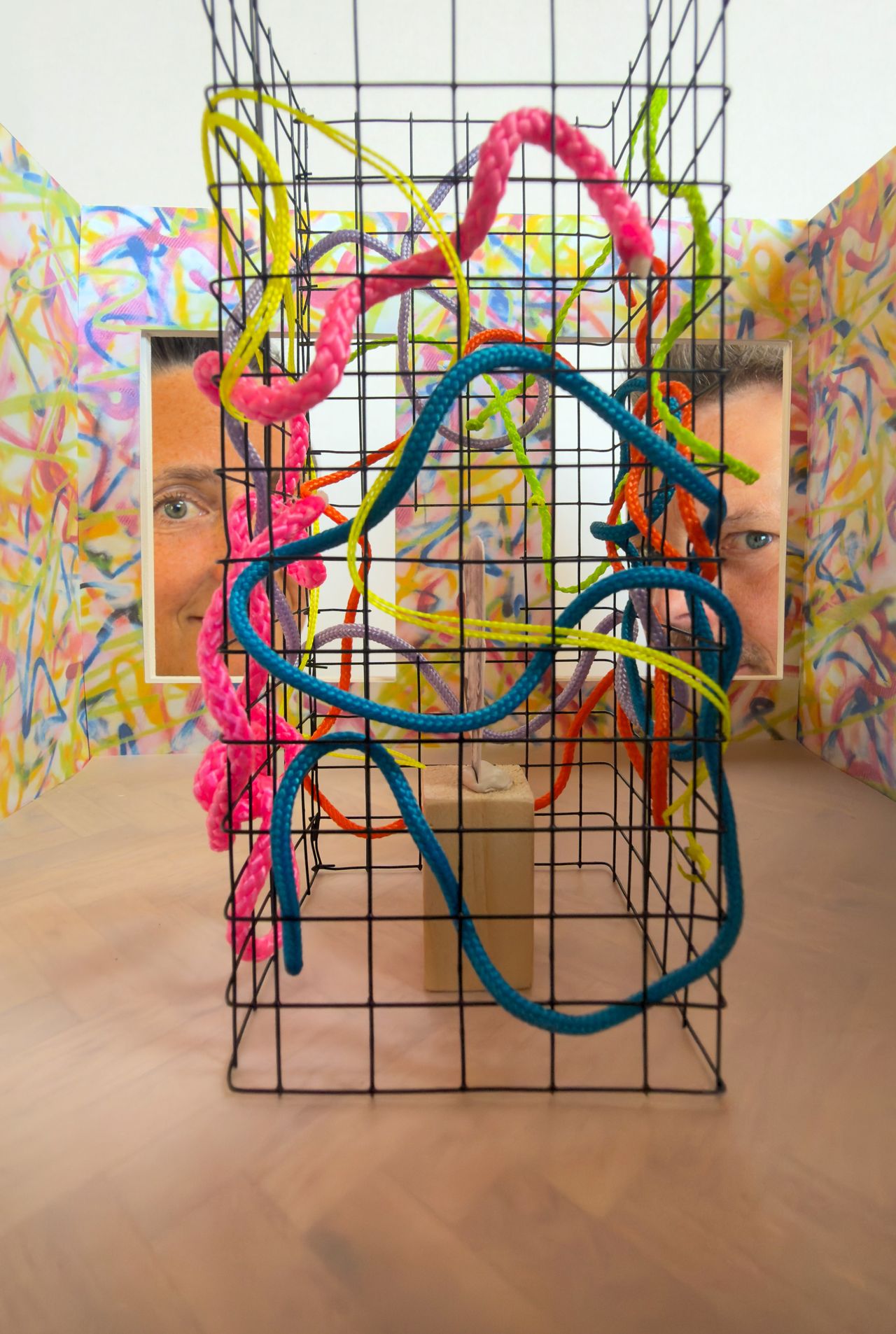
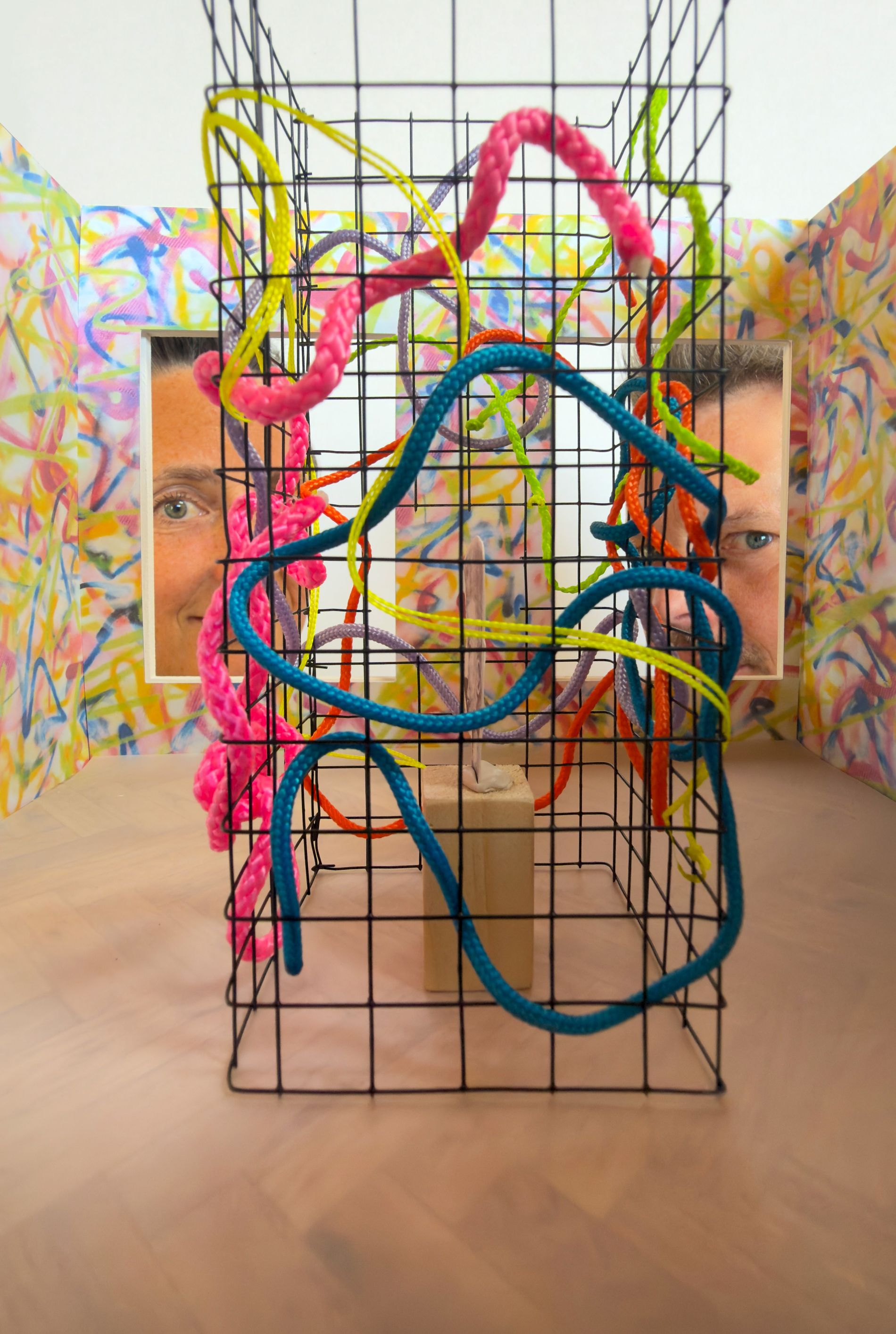
Kiki & Joost is the design studio of Kiki van Eijk and Joost van Bleiswijk, based in Eindhoven. In Weert, they translate the exhibition’s theme into a series of spatial interventions. In each room, they introduce an element that makes the concept of a boundary visible or palpable in some way. Right from the first room, visitors encounter a series of black lines, one of which cuts across the floor—do you step over it? Elsewhere, an installation of glass beads set in a misty, intimate atmosphere challenges visitors to make a personal choice: do you let yourself be touched, or do you keep your distance?
To avoid creating a hierarchy among the exhibited works and to encourage visitors to look at things differently, Kiki & Joost also deliberately opt for unexpected positioning. A work by Nan Goldin, for instance, is not placed centrally in the room but is instead located behind a wall.
Kiki & Joost will present their exhibition design during Dutch Design Week (17–25 October 2026). The scale model will be on display at their studio at Gabriël Metsulaan 1 in Eindhoven.
Here, you will find I Didn’t Cross The Border, The Border Crossed Me | Museum W
Meikoel 2, 6001 EE Weert Plan your route to I Didn’t Cross The Border, The Border Crossed Me | Museum W
Dates and times
- Daily until march 14th, 2027
- Opening hours: Tuesday to Sunday from 11:00 to 17:00.